
Outrightly condemning the police brutality, Naga Students' Federation (NSF) asserted that such attitude towards the peaceful demonstrators was totally "an act of disrespect".
"The federation, therefore, invokes the conscious of the authority concerned and the police personnel to restrain from such unwanted situation especially towards our neighbouring state in order to avoid creating any misunderstanding as we are living in peaceful co-existence," a statement issued by NSF said.
While extending its solidarity to the injured protesters and support towards the demand of the AASU, the NSF also urged upon the Nagaland government to seriously examine the incident and take up necessary action.
Twenty people were injured, some of them seriously, when IRB personnel of Nagaland police passing through Golaghat district unleashed baton charge on demonstrators who blocked the NH-39 on Wednesday demanding improvement of a link road near Rangajan Tinali.
Friday, September 17, 2010
Naga Students Condemn Police Action on AASU

New System to Monitor Seismic Activity in Northeast

"A VSAT-based real time seismic monitoring network (RTSMN) over the northeast consisting of two central receiving stations (CRS) -- one in Shillong and the other in New Delhi -- is under commissioning," meteorological department director Dilip Saha told IANS.
He said the RTSMN would be a satellite based system and it would have 21 stations across eight northeastern states. Approximately Rs.25 lakh would be spent on each station for commissioning the equipment and developing necessary infrastructure.
The RTSMN stations are Guwahati, Tezpur, Dibrugarh, Dhubri, Silchar, Jorhat and Lekhapani in Assam, Yupia, Tawang, Pashighat and Zero in Arunachal Pradesh, Tura and Shillong in Meghalaya, Mokokchung and Kohima in Nagaland, Agartala and Belonia in Tripura, Aizawl and Saiha in Mizoram, Imphal in Manipur and Tadong in Sikkim.
"After commissioning of the RTSMN, more accurate seismic activities relating to earthquake would be known," Saha stated.
The Geological Survey of India (GSI) earlier notified that the mountainous northeast comprising eight states could experience a devastating earthquake as the region is considered by seismologists to be the sixth worst quake-prone belt in the world.
Assam experienced a massive tremor measuring 8.5 on the Richter scale Aug 15, 1950, that claimed some 1,500 lives. The worst quake, measuring 8.7 on the Richter scale, was felt in the region in 1897. It killed 1,600 people.
Tuesday, September 14, 2010
Northeast Activists Appeal China and India to Stop Constructing Dams

In a joint letter to Prime Minister Manmohan Singh and Chinese Premier Wen Jiabao, at least 50 organizations, including the Arunachal Citizens' Right (ACR), have expressed fear that the communities surviving on the river's ecosystem might get destroyed by the politics of water and energy.
China is not only building a series of dams but also diverting water in the upper reaches of the Siang river in the Tibet Autonomous Region (TAR), they claimed.
It would result in massive reduction of water flow that would have irreparable and devastating impact on the ecosystems and the way of life in Tibet, Arunachal Pradesh, Assam and in the lower reaches of Bangladesh, they said.
"We also fear that India's effort to build many dams, including the ones in Lohit and Subansiri rivers, is a way to preempt any Chinese dam upstream using the highly illogical view of stopping dams in upstream by building dams in the lower portion of the river," they said.
The activists have urged both the countries to refrain from building any dams on the river.
"This will help build peace and trust between the two countries. Building dams on Siang or in Yarlung and Tsangpo will therefore be considered as seeking conflict," the organisations added.
Some Martyrs From Northeast Ignored by History Books: Handique

There was considerable resentment against this in the northeast,
Minister for Development of the North East Region (DoNER) Bijoy Krishna Handique said while delivering the keynote address on “History as a window - Understanding North East,” at the Jamia Millia Islamia.
“There should be some recognition of these unsung heroes…The ways of history cannot be corrected but the inadequacy of historical writing can be corrected,” Handique said.
He said the northeast was a “complex region” and made “more complex by lack of understanding of issues”.
The minister said there was need to understand the psyche of the people and respect their sentiments of giving recognition to freedom fighters from the region.
He said the challenge of multi-cultuarlism was not unique to the northeast but it should be studied to understand issues concerning the region and devise a strategy for the future.
Mizoram Chief Minister Pu Lalthanhawla said that the successful Mizo accord can serve as a model peace process for other parts of the country.
The accord was signed in 1986 between the central government and Mizo Nataional Front (MNF). Lalthanhawla had quit as chief minister following the accord to pave way for an interim government headed by MNF leader Laldenga. He had been in and out of office since then and again became the chief minister since Dec 2008.
Lalthanhawla said a spirit of give and take, a willing bureaucracy and total involvement of civil society can make peace accords succeed.
He said the peace process in Mizoram was simpler as there were no multiple ethnic groups in the state.
“Peace, development and governance are closely related. Imbalance in one disturbs the other,” he said, adding that if the mindset of people can be changed, half the battle for peace was won.
Lalthanhawla said the northeast was “least visited and most misunderstood area” of the country, adding there was “a huge communication gap between mainland India and the region” more due to a mental block than geographical factors.
Pointing out that the northeast had a vibrant tradition of local self-government, Lalthanhawla said the region needed more schemes like the national rural employment guarantee scheme to empower the rural masses.
DoNER secretary Jayati Chandra said that bright minds from the northeast who had honed their skills outside the region should also look at the option of returning.
She said that while the government’s per head contribution in the northeast was greater than in any other part of the country, there was virtually no private investment.
She also said that more students from the region should opt for technical courses.
Jamia Millia Islamia vice chanellor Najeeb Jung said that the northeast should be better understood in the rest of the country.
“That is a concern for Jamia. That’s why a centre for northeast studies has been started to focus on the region,” he said.
The vice chancellor said the university was keen that more students from the northeast avail of its courses.
Sanjoy Hazarika of the university’s centre for northeast studies said that development in the region had shown unique flexibility. He said India’s Look East policy should be routed through the northeastern states.
NEEPCO to Upgrade 3 ITI’s in Northeast India

The state-owned corporation will adopt one ITI each in Assam, Meghalaya and Tripura.
NEEPCO last year had adopted two ITIs- one at Halflong in southern Assam and another at Dirang valley of West Kameng district of Arunachal Pradesh.
Under the ‘adopt an ITI’ scheme, a public sector organisation becomes a partner and upgrades an ITI by developing its infrastructure, redesigning the curriculum in consultation with the concerned state government.
‘The main objective of the scheme is to meet the demands of skilled manpower in the developmental projects in the northeastern region,’ a NEEPCO official told IANS.
Call to Develop Infrastructure Along China Border

Talking to The Assam Tribune, Lt Gen Shekhatkar, who is well versed with the ground situation along the border with China in Arunachal Pradesh, said that the Government of India should have initiated steps to boost security measures along the border long back.
He said that though the Government of India is trying to maintain cordial relation with China, the lessons learnt from the 1962 war should never be forgotten and India should always be ready to face any eventuality.
Lt Gen Shekhatkar said that said that for years, the need for increasing the strength of the Army was felt and only now the Government has decided to deploy two additional divisions. He said that the decision to create a battalion of Arunachal Scouts is also a positive development and hoped that the personnel of the battalion would play a vital role in guarding the country’s borders. He said that there should be at least two more battalions of the Arunachal Scouts to deal with the situation.
The former Army officer pointed out that the Ladakh Scouts are doing a commendable job for years and hoped that the Arunachal Scouts would be able to emulate the achievements of the Ladakh scouts. He pointed out that the personnel of the Arunachal Scouts would be well versed with the ground situation and the stake of the local youths in guarding the frontier would be much higher than anyone coming from other parts of the country. Moreover, the creation of the battalion would provide employment opportunities to the local youths, which is also a positive development, he added.
However, Lt Gen Shekhatkar expressed the view that India is still lagging behind China in infrastructure development along the border and only increasing force deployment would not help in case of any eventuality. He said that priority must be given on construction of new roads leading to the international border to facilitate movement of men and machinery whenever required and there must be multiple entry points to the forward posts along the border. At this moment, only one road connects Tawang near the border with China and if that road is blocked, India would have a tough time, he pointed out.
Monday, September 13, 2010
Something New From The Northeast in Bangalore
By Mandakini Dev Sharma

The ANTS store, Indiranagar, is working on a project called ‘Positive stories from the North East’ in an effort to raise awareness about the region in the city.
The store recently held a Manipur Food Festival focusing on the cuisine of Meities, a major Manipuri tribe. ANTS has organised similar evenings around Mizo and Naga food in the past.
“The Manipur Food Festival was organised by a few Manipuris in Bangalore — mainly working professionals and students,” says Devakishore Soraisam, a business management graduate from Christ College who was involved with the event, which was the brainchild of Trichao Thomas of ANTS.
Most cuisines from the North East are unique and very exotic and the same is true for Meitei food. The crowd savoured Manipuri dishes like Shingju, Paknum, Chagem Pomba, Bamboo Shoots, Eromba and Shareng Thongba.
“I loved the eromba, a very common dish which the Meitai prepare from fish, brinjal, potato, bamboo shoot, and chillis,” says Paonam Mahesh Chandra Singh, a Manipuri student.
Naga food is also making inroads in the city — and it’s not just Naga students making a beeline for the newly opened Naga Kitchen in Kamanahalli.
“The menu is very customer-friendly and we expect Bangalore’s foodies to try out North Eastern food,” says Mustaque Ahmed, owner of The Naga Kitchen, Bangalore who expects dishes such as smoked pork chili, smoked chicken fry, fried fish, Naga fried rice and pork Naga curry to do well.
Wednesday, September 8, 2010
Women's Group in Northeast India Gets Global Funding
By Shalini Kathuria Narang

The GFW funding will help the organization to expand a home-based weaving livelihood project running for several years with 90 tribal Chizami women in Nagaland. Through training on skills enhancement, costing, production planning, quality control, and group management, NEN aims to increase the earnings for women, professionalize weavers in a democratic system of working together, and increase the weavers' awareness of their social and economic rights.
Two women began the North East Network in 1995 after participating in the Fourth World Conference on Women in Beijing. Besides New Delhi, the NEN has offices in India's conflict-ridden states of Assam, Meghalaya and Nagaland.
"We aim to bring gendered understanding of human rights violations in the region in the context of conflict, livelihood, and/or health," said Monisha Behal, chairperson, NEN. "One of our activities is to use the (United Nations') Convention on the Elimination of all forms of Discrimination against Women … to influence the State machinery to fulfill its obligations to women. In Meghalaya, we work with the state enforcement authorities on issues of gender and perspectives change especially on violence against women. Its success has influenced NEN Assam, started this year, to do the same."
In Nagaland, she continued, "NEN has addressed ecological conservation through wildlife education. Through the GFW, it is marketing finished traditional Naga weaves in India. NEN has also strengthened biodiversity and conservation measures by helping gauge the value of local plants and herbs and reviving grains like millets in farms."
In Assam too, Behal said, "the cooperation between women's and youth groups, village councils and state agencies is visible. We have also trained several organizations on the Right to Information Act."
By participating in international conventions, including UN meetings regarding Security Resolution 1325, NEN works to highlight the human rights issues facing the women living in the conflict zones of northeast India. It was the first organization in the northeast to create a map of support services available to women in distress.
The group also promotes State accountability by encouraging citizens to use the Right to Information Act, especially regarding land issues, ration allowances and appropriate wage labour.
The group has built partnerships between women's groups and state agencies, including police and medical personnel. It also focuses on building a multi-sector, gender-sensitive approach to violence against women, especially Meghalaya. A community in Meghalaya has donated land for NEN to build a resource centre.
North East Network can be contacted below:
North-East Network
J.N. Barooah Lane, Jorpukhuri,
Guwahati 781001, Assam
Tel/fax: 91 361 2631582/ 2603833.
email: assamnen@yahoo.co.uk
Monday, September 6, 2010
14 Youths From Northeast to Climb Nepal Peak
 Imphal, Sep 7 : Fourteen youths from the Northeastern region, including four girls, will scale the Nepal Peak as a precursor to the Mt Everest expedition planned next year.
The pre-Everest Nepal Peak Expedition of the Manipur Mountaineering and Trekking Association (MMTA) was flagged off by N Biren Singh, Minister, Youth Affairs and Sports, and Maj Gen DS Hooda, GOC 57 Mtn Div, Chief Patron of Manipur Mountaineering Institute, yesterday.
The expedition, led by L Surjit Singh, president MMTA, will try to summit the Nepal Peak (7168m) from the Sikkim approach on September 25.
The 14 member contingent, which includes four ladies, has been drawn from different states of the region. The expedition has been organized under the aegis of the Indian Mountaineering Foundation (IMF) and sponsored by the North Eastern Council.
Surjit Singh, team leader, said the expedition is a precursor to the Everest Expedition being planned next year. He urged the state government and other adventure lovers to support the forthcoming Everest Expedition.
Minister of YAS N Biren Singh, while wishing the team great success, thanked the Indian Army for the assistance and support towards sports and youth programmes.
Sunday, September 5, 2010
India Betting Big on Rs 1,700 cr Project in Northeast

"We are betting big on the ambitious Kaladan multi-modal project. Once complete, bilateral trade would grow manifold. It will also help in overall development of the Northeast region and particularly land-locked states like Mizoram," the Minister of the Department of the Northeast Region, B K Handique, told PTI.
At present, essential commodities such as rice and other consumer durables are brought into the region through 'the chicken neck corridor' via Siliguri. This route is not only long, but is also time consuming and highly congested, a government official said.
In this light, India and Myanmar had in 2007 inked a pact to set up a multi-modal project, which comprises building a port, inland waterway facility and connecting road in the neighboring country. India is funding the mega-project, which aims at bringing goods into the Northeast through Myanmar.
"The Kaladan project envisages connectivity between India ports on the eastern sea board and Sittwe Port in Myanmar and then riverine transport and by road to Mizoram, thus providing an alternate route for northeastern India for the transportation of goods," Handique said.
In addition to the Kaladan project, India is already in a dialogue with Bangladesh to develop a rail link between a bordering town in Meghalaya to Chittagong in Bangladesh, which is a port city. The government is working to develop more routes to ship goods in the Northeast region.
Critics of the project say that the multi-modal project is expensive and "time consuming". But Handique said the project will further India's 'Look East' policy and make the Northeast region the "vanguard" of policy to foster ties with East Asian countries.
Under the multi-modal project, it is envisaged to ship goods from the Kolkata port to Myanmar's Sittwe Port, which is being developed by the Essar Group at a cost of over Rs 311 crore. The sea distance between Kolkata and Sittwe is 539 km.
From the Sittwe Port to Setpyitpyin in Myanmar, an inland waterway route is to be developed along the river Kaladan. From Setpyitpyin to the Myanmar-India border, a 62 km road is to be built to carry the cargo.
Finally, from the international border, national highway NH-54 would be stretched by 100 km to touch Lawngtlai, in Mizoram, for bringing the goods to the most populous part of the region. The entire project could cost about Rs 1,700 crore, a government official said.
"The overall project is scheduled to be operational by 2014-15," Handique added.
In 2009-10, India and Myanmar had trade worth $1.5 billion, up about 30 per cent from 2008-09.
Northeast Women in Delhi Protests Against Sexual Assault
By Ninglun Hanghal
New Delhi, Sep 5 : Several women and students from Manipur gathered in front of the "Wow" restaurant and bar at Delhi's Connaught Place holding placards and festoons strongly condemning the alleged sexual assault of a woman from the Northeast region, by the Manager of the restrobar where she worked.
Besides condemning the sexual assault the students and women from Manipur and other States of Northeast demanded speedy processing of the FIR.
The girl, from Manipur, worked at the said restrobar on and she was physically assaulted by the Manager on the charge that she was watching TV instead of attending to her duty on August 24 night.
The girl on the other hand, fought back and accused the Manager of trying to sexually molest her and approached the police lodged a complaint.
Organizations set up by people and students from the Northeast also took up her case.
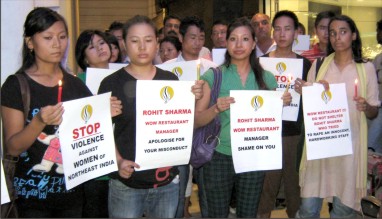
NE students protesting at the Connaught Place police station
With restrictions imposed under CrPC 144 in and around Connaught Place, the OC of Connaught Place police station called in the demonstrators for a meeting at the police station and reportedly informed the co-coordinator of the demonstration, Ms Lemyao Shimray to discuss the matter along with the said victim.
When Ms Shimray inquired about the status of the FIR, the police officer replied that the accused, the Manager of the restaurant, has been arrested.
Speaking to the media, Mr Mukesh, who has taken over as Manager of the restrobar said, "The owner was not in town when the incident took place, and so Rohit Sharma (the accused Manager) was here till August 27". On the incident, the new Manager said, "I cannot comment now, the law will take its own course".
He further said "this is the first time that such an incident that has happened in our restrobar and many people from the Northeast are still working here, and this is the proof of the good atmosphere of this restaurant ".
Till the time of filing this report late in the evening the demonstrators were at the police station.
Wednesday, September 1, 2010
More Forces Deployed For NH-39 and NH-53 in Northeast

The 12 CPMF comprise six companies of Central Reserve Police Force and six companies of Border Security Force.
Speaking on the issue of internal security, the Home Minister informed reporters about the North East, Jammu and Kashmir, and on the issue of Left Wing Extremism.
About northeast, the Home Mininster informed that a committee has been set up on August 10, 2010 to examine various issues related to Chakmas / Hajongs, which include their settlement in Arunachal Pradesh and grant of Indian citizenship to eligible members.
A tripartite agreement was signed with a Meitei outfit in Manipur, the Kangleipak Communist Party (Military Council) - Lallumba faction on August 6, 2010, he said and added: "As a result, 114 cadres surrendered with 81 weapons."
The Home Minister said, "Measures are being taken to rehabilitate all surrendered cadres."
He also informed that the tripartite SoO (Suspension of Operations) with the Kuki National Organisation (KNO) and the United People's Front (UPF) was extended by 45 days on August 22, 2010.
"This agreement has been in effect since August 22, 2008," Mr. Chidambaram informed this today while presenting the report card for the month of August.
Speaking about the Amarnath pilgrimage held in Jammu and Kashmir, the Home Minister said: "The annual Amarnathji Yatra concluded on August 24, 2010. Since July 1, 2010 a total of 458,000 pilgrims visited the shrine. Full security was provided to the yatra and no incident of violence was reported." (ANI)
Most Northeast Crafts Ignored at INA Metro Culture Gallery
By Subhendu Ray

But the crafts and craftsmen of northeastern states got very small space in the first of its kind 'Crafts of India' gallery at INA Metro Station. The gallery, which showcases 58 panels made by
craftsmen and weavers from across the country, has just one hand-woven shawl from Manipur and Nagaland each. No other northeastern state has any representation in it.
In a bid to showcase the rich and varied handicrafts and handlooms of India, textiles ministry and the Delhi Metro Rail Corporation (DMRC) jointly installed the gallery. Another reason for the gallery was to give a boost to the commercial activities at Delhi Haat, which is in vicinity of the INA Metro station.
Said textiles minister Dayanidhi Maran while inaugurating the gallery on Wednesday: "This gallery provides a platform to every state which have rich heritage of handicrafts and handlooms."
He said that keeping this in mind his ministry has ensured participation of all states whose craft works are rich.
DMRC managing director E. Sreedharan proposed that the textiles ministry install similar galleries at other stations and in some trains, too, to promote India's crafts and culture.
Tips From Heartland, South For Craftsmen

Visitors admire jewellery at the Cluster Conclave in Guwahati on Monday.
Guwahati, Sep 1 : Woodcarvers of Saharanpur in Uttar Pradesh and goldsmiths of Machilipatnam in Andhra Pradesh have helped the carpenters of Baktawng in Mizoram and jewellery makers of Manipur to add quality to their products for better market and value.
The products were displayed at the Cluster Conclave organised by the IIE (Indian Institute of Entrepreneurship), which concluded in Guwahati today.
The artisans from Mizoram and Manipur said the training has provided them access to new technology, which will help their products secure better markets now.
“We did not have access to better tools and hence our products lacked quality. The trip to Saharanpur has helped us to acquire designing skills and gather knowledge to make our products more competitive in the market,” Mawiluizela, a resident of Baktawng of Mizoram, told The Telegraph today.
Baktawng is 70km from Aizawl and is famous for its fine carpentry and wood carvings.
The total number of households in the villages is 140 of which 85 are engaged in wood carpentry.
The training in Saharanpur, internationally famous for its wood carving industry, has helped the artisans of this Mizoram village to enrich the designs and the quality of the wood carvings, which were earlier considered simple.
The finished wooden products of Baktawng cluster include door panels, ventilation frames, tables and dining tabless.
A common facility centre at this village in Mizoram has been sanctioned by the Union ministry of micro small and medium enterprises, which would help them in getting necessary tools.
“It has also helped them in opening up their world outlook and learning new facets, which would help them in getting good markets,” said Sriparna Baruah who heads the Regional Resource Centre that is responsible for cluster development at the IIE.
Similarly, the artisans from the Greater Imphal Jewellery Cluster had gone to Machilipatnam in Andhra Pradesh to learn about the tools for jewellery.
“We had engaged a new designer for the cluster and she has given 15 new designs by blending the intricate Manipuri designs with modern looks thereby introducing costume jewellery in the cluster,” Baruah said.
The Greater Imphal Jewellery Cluster has two villages within its fold, Malom and Kanglambam, which are spread within a radius of 5km.
“People of Manipur love gold jewellery. There are units in the cluster that exclusively make ornaments, which are intricately and traditionally designed for various occasions,” Baruah said.
Monday, August 30, 2010
Northeast Bar Girl Alleges Molestation by Boss in Delhi

The accused is the manager of the bar. New Delhi district police has registered a case of molestation.
The victim, a resident of Manipur, has alleged that her manager first hurled abuses at her and then pushed her off her chair before trying to molest her.
"I was alone on the first floor of the restrobar when he attacked me with a fork. I suffered bruises," the woman told police.
She added that when she raised an alarm other employees of the restrobar rushed to her rescue.
"The accused has accepted that he did scold her but refuted all other charges. We have taken the victim, who has been working at this restaurant-cum-bar for the past three months, to RML Hospital for a medical test. We are investigating the case," said an officer.
Additional commissioner (New Delhi) Shankar Dash said, "As it is a case of molestation against a girl from northeast, we are treating the case seriously."
The girl, who lives with her brother and cousin at Kotla Mubarakpur in south Delhi, vowed that she will never set foot on the restrobar again.
"Now, I do not want to go back to duty. They did not remove me from my post. I left the job on my own volition," she said.
Sunday, August 29, 2010
Indian Govt Chase to Clear UNESCO Language Haze

Sixty-four languages that the latest UNESCO World Atlas of Endangered Languages describes as endangered are spoken in the Northeast and along the India-Nepal border. Thirty-nine are spoken in the Northeast alone.
“Many of the languages listed as dead or endangered are very much alive and kicking. The government has decided to send fact-finding teams to every state to document the tribal languages, especially those declared dying or dead by UNESCO,” a tribal affairs ministry official said.
The Centre for Tribal and Endangered Languages, a division of the Central Institute of Indian Languages, Mysore, has been assigned the job. “The CIIL will bring out a white paper. That would be hard evidence which can be presented before any international body,” the official said.
Work is already on with the head of the Centre for Tribal and Endangered Languages, Prof. G. Devi Prasada Shastri, visiting the Northeast.
Tribal leaders had brought the matter to the government’s notice. “We received representations that the widely spoken Aimol and Tarao had been put on the Unesco list,” the official said.
The two languages figure on UNESCO’s critically endangered list, which would mean they are spoken only by the elderly and that too infrequently and partially. Aimol Literature Society chairman S.L. Warte termed the Unesco report “unfortunate” and demanded correction.
“The population that speaks Andro, Aimol and Tarao may not be large, but these languages are being spoken,” said Ch. Jashobanta, a linguistics professor at Manipur University.
Jashobanta, however, agreed that the languages would count as endangered by international standards because less than 10,000 people speak them.
The CIIL says there is confusion over the definition of language. “Most languages listed in UNESCO’s e-atlas are not considered languages but mother tongues in India. We go by the Census 2001 definition. If there are 10,000 or more speakers, it’s a language, else it’s a mother tongue,” a CIIL researcher said.
Mother tongues are not included in the Eighth Schedule, a list of 22 officially recognized languages. “Only if a language is in the Eighth Schedule will it be taught in schools as part of the three-language formula,’’ said Aravind Sachdeva, a specialist on tribal languages. He pointed to an increasing tendency among tribals to speak Hindi or English as the reason for their languages being labeled endangered.
But Asam Sahitya Sabha president Rongbong Terang and educationist Tabu Ram Taid believe tribals can protect their languages. “I don’t think any tribal language of Assam would ever become extinct. I can speak Assamese, English, Hindi and many other languages. But my mother tongue is Karbi and I speak Karbi with my family and friends,” Terang said, describing the UNESCO report as exaggerated. Karbi is on the list as a vulnerable language.
Taid, closely associated with the preservation of his mother tongue Mising, too disagrees with the UNESCO report. Mising, on UNESCO’s endangered list, is spoken by 517,170 people out of a population of 587,310, according to the 2001 census. “Mising today has a firm written tradition and has even been introduced in primary schools,” Taid said.
An email seeking UNESCO’s response went unanswered till Saturday evening.
Braving The Odds: Northeast Migrants

Many skills at hand.
Migrants from the North Eastern States are appreciated in other metros for their commitment to work. But the road to success is not all easy…
They wore short red pleated skirts, striped stud-buttoned shirts, big cowgirl-style hats and black boots up to their calves. Some had eyebrow piercings, others small tattoos on their arms.
With polite manners and attendant to all the guests of the party, these Manipuri women comprised the catering service at my cousin's recent wedding in Hyderabad. It was quite affronting at first to see their ‘uniforms', especially in contrast to the more conservatively dressed women in their bejewelled saris and best ornaments.
The waitresses reminded me of Thai women working in an American-themed restaurant/bar I'd seen in Bangkok. But when I asked others at the wedding what they thought of the servers and their outfits, no one else seemed to notice them. They were merely the ‘new item' in the perpetual race to have the most elaborate wedding.
“They like to have us greeting customers because maybe our skin is a little fairer than other Indians,” says Vung, 22 from Churachandpur, Manipur in Northeast (NE) India. She left her hometown three years ago after completing school.
Since then she has been working in places like Subway and Pizza Corner. She currently works in a retail shop in Chennai. She also studies history at Madras University and lives with her sister in a flat near her work. “We share the rent so we can send more money home to our parents,” says Vung.
Search for jobs
Thousands of educated girls like Vung, from Manipur, Meghalaya, Mizoram, and Nagaland come to work in call centres, the IT industry, retail and the hospitality industry in India's biggest cities. There are few educational or employment opportunities for them in their home states.
Leaving behind a very unstable political and economic climate and dismal infrastructure, they also leave their families, sometimes travelling for days on the small tip from a relative or friend, that they will find work in the metros of India. Many Manipuri women work in the hospitality ad retail industry.
They are conspicuous, not just because of their ‘East-Asian' appearance, but also because women do not traditionally do the jobs they do. “It was really difficult to get any women to work here. I needed them to work late and even if local girls were interested, their parents wouldn't allow them,” says Ciro Cattaneo, owner of Bella Ciao in Chennai.
The only females willing to work were the Manipuri girls. “People might misunderstand us, but we are just doing our work and going home,” says waitress Ngai Muan Sang, 18. She says that she is called Jeslin as people find her name too difficult to pronounce.
She's been working for the Italian restaurant for six months. “South Indians are very curious about us and are always asking if we are from Japan, Thailand or China. They don't know we are Indian,” Ngai says, adding that she often has to explain that Manipur is in India.
It is this lack of understanding of where they come from, their ‘otherness,' that allows these women to do the jobs that are traditionally not considered appropriate for local girls.
“For some reason, parents here don't like their girls to work in restaurants or cafes,” says Samir Nanaviti, owner of the Mocha café, Indira Nagar, Chennai. All his female waiting staff hail from the Northeast . He says that it wasn't a policy to have all North Eastern female staff, but they were the only ones applying.
Although there is no official data, most North Eastern migrants move to Delhi, with an estimated 100,000 residing there, followed by Kolkata, Bangalore, and then Chennai.
In Delhi, about 85 per cent of the migrants are students. They take part-time jobs to support themselves. “They are very independent. They don't like to depend on their parents for everything like other Indian girls,” says Professor Savita Singh, Director of the School of Gender and Development Studies, Indira Gandhi National Open University, New Delhi.
She sees the presence of North Eastern women in non-traditional female jobs as a reflection of society as a whole. “Our patriarchal system constantly exploits women. They work very hard, unpaid in their households. The North Eastern States have a different understanding of ‘household' where men and women are more equal.”
They also have a reputation of being slim built, at ease in Western outfits and comfortable in English. These attributes are sometimes used against them and many NE women are harassed and abused.
The North East Support Centre & Helpline (NE Centre) was founded in New Delhi eighteen months ago by concerned NGOs to assist such girls in distress and in danger of physical and psychological harm.
Lansinglu Rongmei, Advocate and President of the NE Centre says, “We get many phone calls from girls who have been abused but it's very difficult to deal with the local authorities. They don't seem to care about NE women.” Madhu Chandra, spokesperson of the NE centre, says 10,000 NE migrants are estimated to be arriving in Delhi each year. The majority are from Assam, followed by Manipur and Nagaland.
Pros and cons
Chin, 30, from Manipur and the assistant manager of human resources in a Delhi Mocha café, has been in Delhi for 15 years. She loves living in Delhi and says, “Good experiences and bad experiences come in a package. If it's your destiny, then you have to face it.”
She believes that the South must be much safer than the North as she hasn't heard of any major assault cases like those in Delhi.
However, as places like Bangalore and Chennai offer more employment opportunities, North Eastern migrants are becoming increasingly visible in the South. Akeh, 23 from Manipur, working in Mocha café, Bangalore, echoes Chin, “Sometimes there are rowdy, bad guys, trying to steal our things, but there are also good people here.”
In between greeting guests at the shop, Vung says she has no plans to return to the North East . “I like it here, I want to stay longer even though I miss my parents. It's nice to stay and not waste time at home where there's not much work. ”
via The Hindu
Friday, August 27, 2010
Work to Link Myanmarese Port 'On Schedule'

Answering questions, Minister for External Affairs S M Krishna said in written replies that the Kaladan project envisaged connectivity with Indian ports on the eastern seaboard and Sittwe port through riverine transport and by road to Mizoram.
The Framework Agreement and Protocols signed in April 2008 envisaged the completion in five years. It will provide a route for transport of goods to north and east India and is not linked to transit facilities provided through Bangladesh, the minister clarified.
Answering questions on the problems of enclaves along Indo-Bangladesh border, the minister said both sides were finalizing the date of the next Joint Boundary Group meeting.
People living in Indian enclaves in Bangladesh were excluded from census as no access to these enclaves were provided by the Government of Bangladesh for census operations.
To a question on Chinese objections for construction of civilian roads in the proximity of International Boundary line/Line of Actual Control in Ladakh by the J&K Government, the minister said such works could not be undertaken without the Central government. In the absence of such approvals, NREGA work in Ladakh had been halted.
On setting up of overseas military bases in the neighborhood of India, Mr Krishna said the Government was aware of the media reports and it kept constant watch on all developments having a bearing on India's security and took all measures to safeguard it.
India Assures of Reviewing Gas Price For Northeast

Talking to mediapersons here, Mr Dey said a four-member delegation of Northeastern Regional Power Committee (NERPC), comprising power ministers of Tripura, Meghalaya, Nagaland and Assam, met both Union Petroleum and Natural Gas Murli Deora and Union Power Minister Sushil Kumar Shinde on August 25 last.
He said almost 48 per cent of power was generated from natural gas in the Northeast, but suddenly the Petroleum Ministry hiked the price of natural gas from Rs 2,112 per cubic metre to Rs 5,152.
The hike in the price adversely affected both power generation and industrial development in the region, he charged.
The delegation had demanded roll back of the hike in prices of natural gas in the region to stabilize the prices of power, Mr Dey said and added that both the Union Ministers were positive to the demand.
''Northeast is sharing its power generation with the rest of the country as per agreement with the Centre, but other parts of the country do not consider to share their power with the Northeastern states and that is why we pressed for the demand of sharing power from upcoming mega-power project of Orissa,'' Mr Dey underlined.
Mr Shinde, however, asserted that the Power Ministry was sincerely trying to bring up four mega-power projects of the Northeast-- gas-based 726 MW plant in Palatana, coal-based 750 MW thermal power plant in Boangaigoan, 600 MW and 2,000 MW hydro-power plants in Subarnasiri and Kameng respectively-- as soon as possible to manage the deficiency in peak hour.
The delegation also demanded the Centre to incorporate Sikkim in the NERPC, timely commissioning of hydro and thermal projects in the region and upgrade transmission infrastructure for economic development.
Assam, Arunachal Meeting Held to Ease Tension

A high-level meeting between the two governments was held here to ease the inter-state border tension at Charaipung area where it was decided that bunkers erected by Arunachal Pradesh police between Charaipung and Teok river will be removed immediately.
The area will also be jointly patrolled by Assam and Arunachal Pradesh police, which can have a patrol party in the Wangchu villages to instill confidence among the villagers, the meeting decided, official sources said.Similarly, Assam Police can also have a patrol party in the small tea garden areas for bringing confidence among the tea growers till the situation becomes normal, they said.
The meeting also decided that Arunachal government would take necessary steps to stop public display of arms by the villagers in the area.
It was resolved that the Assam government would take necessary steps to immediately withdraw additional police force deployed in the area since August 14.
To avoid firing by both the state police forces due to any misunderstanding, the meeting decided that local police officers would remain in constant touch. The meeting, attended by Assam's acting chief minister Bhumidhar Barman and Arunachal Pradesh's Finance Minister Setong Sena among others, also decided that strong action would be taken against the militants in the area if there is any display of sophisticated arms by them or there is any extortion attempts by them.
The meeting further appealed to organisations concerned to withdraw their economic blockade for preventing essential goods reaching Arunachal via Assam in the interest of the general public of both the states.
If the appeal was not honoured, the Assam government would take necessary steps to remove the blockade.An appeal was also made to the media for its cooperation in bringing normalcy in Charaipung in Assam's Sibsagar district where violent incidents by some Arunachali miscreants allegedly aided by NSCN-IM militants has been continuing since August 14, the sources said.
The meeting also decided to endorse the decisions taken for restoring peace at the ministerial level meeting between Arunachal home minister and Assam Law Minister Pranab Gogoi on August 19 at Bimalapur in Sibsagar.Besides Barman, the Assam side was represented by Gogoi, Forest Minister Rockybul Hussain, Health Minister Himanta Biswa Sarma and Border Area Development Minister Gautam Roy.
The Arunachal side also included Principal Secretary Th Wangham, Home Commissioner Tajom Taloh, IGP S B K Singh, advisor to chief minister Tane Phassang and Arunachal Pradesh Citizens rights activist Bamong Tago.


